Empowering Young Minds Through Holistic Skill Development
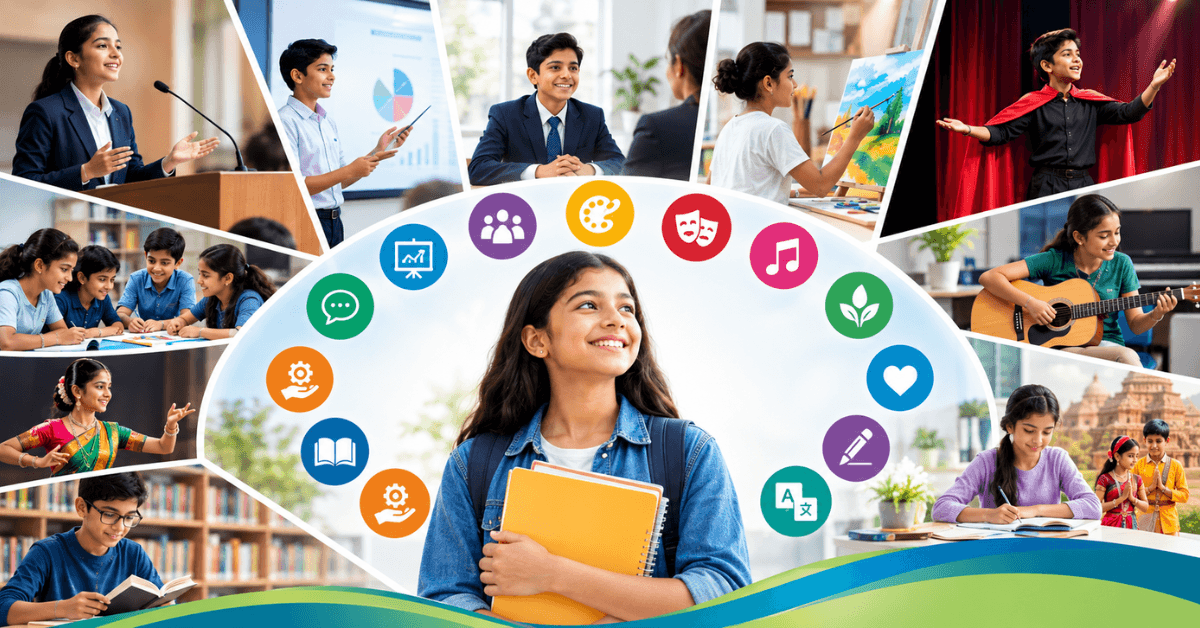
Education is no longer limited to textbooks, examinations, and academic achievements. In today’s rapidly changing world, children and young people need a broad range of skills to communicate confidently, think creatively, express themselves, work with others, make responsible decisions, and adapt to new situations. Holistic skill development brings together communication, creativity, performing arts, life skills, values, culture, and language to support the overall development of an individual.
The following areas provide a strong foundation for building confident, creative, responsible, and capable individuals.
Skill OnePublic Speaking
Public speaking is an essential skill that helps individuals express their thoughts clearly and confidently before an audience. It develops communication ability, confidence, listening, vocabulary, and leadership qualities.
Activities such as storytelling, speeches, debates, group discussions, role plays, and short talks provide children with opportunities to overcome stage fear. Regular practice teaches them how to organize their ideas, use appropriate body language, maintain eye contact, and speak with clarity.
Public speaking is not simply about speaking loudly; it is about communicating ideas effectively and connecting with an audience.
Skill TwoPresentation Skills
Presentation skills enable learners to communicate information in an organized, engaging, and meaningful manner. A good presentation combines content, communication, visual elements, and confident delivery.
Students can learn to structure presentations with a clear beginning, meaningful content, and strong conclusion. They can also develop skills in using charts, images, posters, slides, and storytelling techniques.
Presentation activities encourage learners to research a topic, identify important information, organize their thoughts, and present them creatively. These skills are valuable in classrooms, workplaces, meetings, seminars, and professional environments.
Skill ThreeInterview Skills
Interview skills prepare learners for important academic and professional opportunities. A successful interview requires more than knowledge; it also requires confidence, preparation, appropriate communication, active listening, and positive body language.
Mock interviews can help learners understand how to introduce themselves, answer questions thoughtfully, discuss their strengths, respond to challenging questions, and maintain professional etiquette.
Learning interview skills at an early stage helps individuals become more comfortable communicating with teachers, professionals, employers, and unfamiliar people.
Skill FourPainting
Painting provides children with a powerful medium for creativity and self-expression. Through colour, shapes, lines, and images, learners can communicate ideas and emotions without relying entirely on words.
Painting develops observation, imagination, concentration, patience, hand-eye coordination, and aesthetic awareness. Activities such as nature painting, poster making, drawing competitions, theme-based artwork, and community art projects can make learning enjoyable.
More importantly, painting gives children the freedom to explore, experiment, and create something uniquely their own.
Skill FiveDrama and Solo Acting
Drama encourages learners to understand people, situations, emotions, and different perspectives. Through theatre and acting, students develop confidence, communication, teamwork, memory, expression, and problem-solving skills.
Solo acting is particularly useful for developing individual confidence. Monologues, character portrayal, storytelling, and dramatic presentations encourage learners to use voice, facial expressions, gestures, and movement effectively.
Drama can also make academic subjects more interesting by transforming lessons into stories, characters, and real-life situations.
Skill SixDance and Music
Dance and music contribute significantly to emotional, physical, social, and creative development. Dance improves coordination, rhythm, body awareness, discipline, and confidence, while music develops listening, memory, concentration, creativity, and emotional expression.
Group performances also teach cooperation and responsibility. Learners understand that successful performances depend on preparation, practice, timing, and teamwork.
Traditional music and dance can additionally introduce children to India’s rich cultural heritage and diverse artistic traditions.
Skill SevenLife Skills
Life skills prepare individuals to manage everyday situations and make thoughtful decisions. Important life skills include communication, decision-making, problem-solving, teamwork, time management, emotional awareness, self-management, adaptability, and responsible behaviour.
Practical activities such as group tasks, simulations, problem-solving exercises, leadership activities, and real-life projects can help learners apply these skills.
The objective is to help young people become more independent and capable of handling challenges with confidence and responsibility.
Skill EightEthics and Culture Skills
Education should also develop character and social responsibility. Ethics and culture skills help learners understand values such as honesty, respect, empathy, fairness, responsibility, compassion, and cooperation.
Understanding culture helps children appreciate their own heritage while respecting the traditions, languages, beliefs, and practices of others. Stories, folk traditions, festivals, literature, community activities, and discussions about ethical situations can make these concepts meaningful.
The goal is to develop individuals who are not only capable but also responsible members of society.
Skill NineLanguage Skills
Language is one of the most important tools for learning and communication. Strong language skills help individuals read, write, listen, speak, understand information, and express ideas effectively.
Language development can include vocabulary building, reading, storytelling, pronunciation, grammar, comprehension, conversation, creative expression, and public communication.
Encouraging learners to read books, participate in discussions, tell stories, write regularly, and communicate in different contexts can strengthen both confidence and competence.
Skill TenCreative Writing Skills
Creative writing gives learners the opportunity to transform imagination and ideas into meaningful words. It develops vocabulary, observation, imagination, critical thinking, emotional expression, and communication.
Students can explore short stories, poems, dialogues, personal narratives, scripts, descriptions, journals, and imaginative compositions. Creative writing should encourage experimentation rather than focusing only on grammatical perfection.
When children are encouraged to write about their experiences, dreams, surroundings, and ideas, they begin to discover their own voice as writers and thinkers.
Conclusion
Public speaking, presentation, interview skills, painting, drama, dance, music, life skills, ethics, culture, language, and creative writing are interconnected areas of holistic development. Together, they help learners move beyond memorizing information and develop the ability to communicate, create, collaborate, think, perform, and make responsible choices.
A strong educational programme should therefore provide regular opportunities for learners to practise these skills through projects, performances, workshops, competitions, discussions, creative activities, and real-life experiences.
The ultimate purpose of education is not merely to prepare students for examinations. It is to prepare them for lifewith confidence in their voice, creativity in their thinking, respect for others, awareness of their culture, and the skills necessary to face the future with purpose and responsibility.